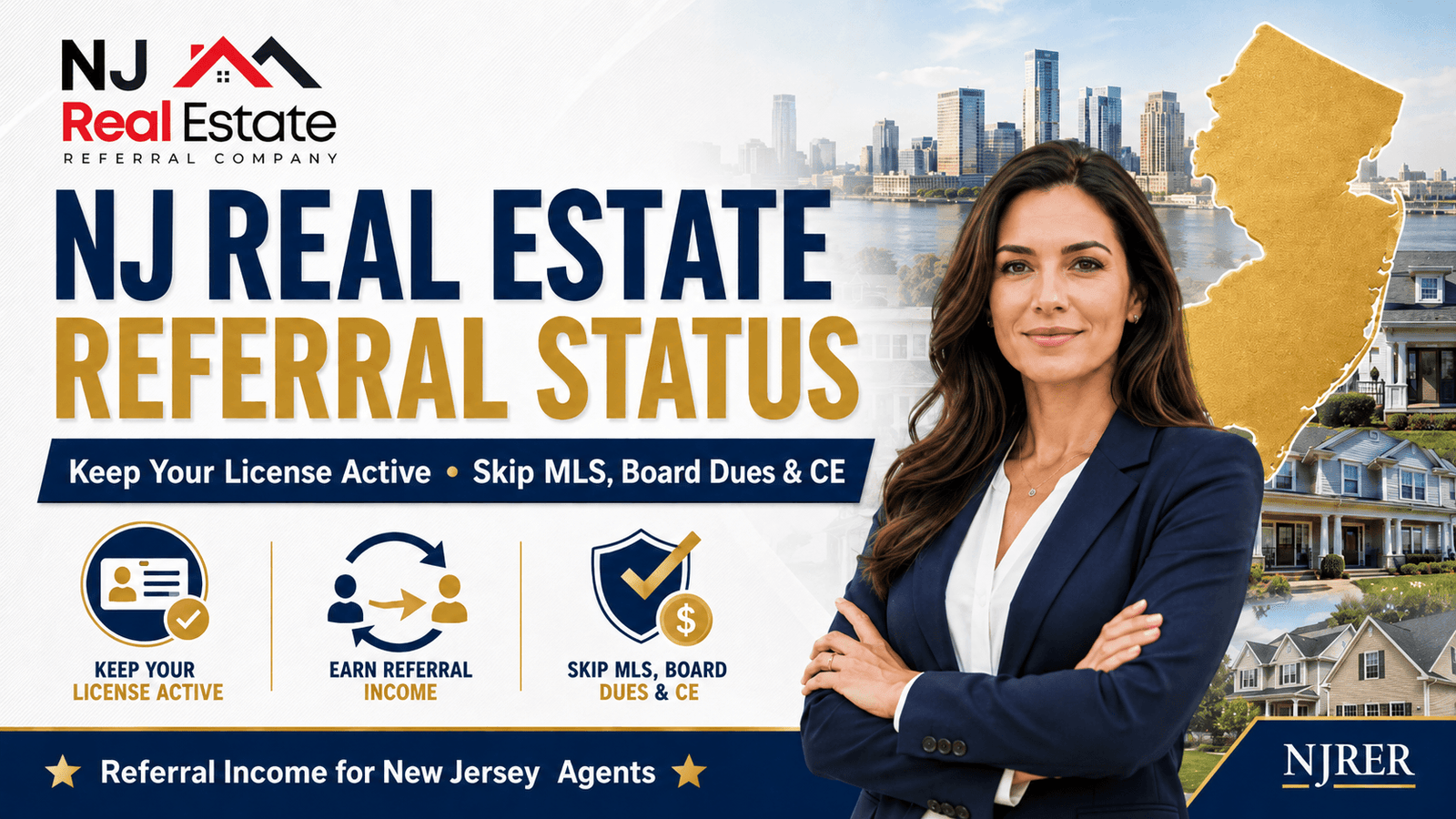
NJ Real Estate Referral Status Guide: Keep Your License Active Without MLS, Board Dues or CE
For many New Jersey real estate agents, referral status is the cleanest way to protect the value of a real estate license without staying trapped in the full-time cost, continuing obligations, and daily pressure of active sales.

For agents who are burned out, semi-retired, working in another industry, raising a family, managing another business, relocating, or simply tired of paying fees for a business they are not actively using, referral status can be a practical way to keep a real estate license working without the full expense and workload of active sales.
This guide explains what NJ real estate referral status is, who it helps, why it matters, and how New Jersey agents can use it as a smarter license-preservation strategy.
What Is NJ Real Estate Referral Status?
NJ real estate referral status is a licensing path for New Jersey real estate licensees who want to remain licensed but do not want to actively practice traditional real estate sales. Instead of working as a standard active salesperson, the agent places the license with a licensed New Jersey real estate referral company and limits activity to referrals.
In plain English, referral status means you can stay connected to the real estate business without doing the daily sales work.
You are not trying to be the listing agent. You are not driving buyers from house to house. You are not preparing listing presentations. You are not writing contracts. You are not managing home inspections. You are not negotiating repairs. You are not sitting at open houses on weekends. You are not carrying the normal operating costs of an active agent business.
Instead, your job is simple: when someone you know needs real estate help, you refer that person to your supervising broker or through your referral company’s approved process. If the referred person completes a transaction and a referral fee is earned, you may receive referral compensation through the brokerage according to your agreement.
That distinction matters. Referral status is not the same as letting your license expire. It is not the same as walking away from the industry. It is not the same as becoming unlicensed. It is a more limited license relationship designed for agents who want to preserve referral-income opportunities while stepping away from active brokerage work.
Why NJ Agents Search for Referral Status
Many New Jersey agents start researching referral status when the cost of staying active no longer makes financial sense.
Some agents are paying for Realtor association dues, MLS access, lockbox fees, continuing education, business cards, signs, websites, advertising, CRM tools, lead platforms, transaction software, and other business expenses. Those costs may be justified when an agent is actively producing listings and closings. But if an agent only closes one deal every few years, or has stopped actively selling altogether, the math changes.
For many agents, the real question becomes:
“Why should I keep paying active-agent expenses if I am not actively selling real estate?”
Referral status gives that agent another option. Instead of losing the license completely, the agent can move into a referral-only model and continue earning from introductions.
This is especially attractive for agents who still have strong personal networks. A former full-time agent may still know dozens or hundreds of people who trust their judgment. A retired agent may still receive calls from past clients. A mortgage professional may meet buyers every month. A title professional may hear about property transfers. A landlord may know tenants who want to buy. A business owner may know families moving in and out of New Jersey.
These relationships have value. Referral status helps preserve that value.
Who Should Consider a New Jersey Real Estate Referral Company?
A New Jersey real estate referral company can be a good fit for several types of licensees.
1. Agents Who Are Tired of Paying MLS and Board Fees
If you are not actively listing or selling homes, MLS access may not be worth the cost. The same may be true for local board or association dues. Many agents reach a point where they are paying for tools they rarely use. Referral status may allow them to step away from those expenses while keeping a path to referral income.
2. Agents Who Do Not Want to Complete Continuing Education
Continuing education is a major reason agents explore referral status. Active salespersons, broker-salespersons, and brokers generally have continuing education obligations tied to license renewal. Referral agents have different rules. Agents should always confirm their own situation with the New Jersey Real Estate Commission or a qualified licensing professional, but referral status is commonly used by agents who want to avoid the continuing education burden associated with active sales practice.
3. Semi-Retired or Retired Agents
Many successful agents do not want to fully disappear from real estate. They may no longer want to manage listings or buyers, but they still have past clients, friends, relatives, and community relationships. Referral status lets them continue benefiting from the reputation they built over the years.
4. Part-Time Agents Who Are No Longer Producing
Part-time real estate can be difficult. If you have another job or business, it may be hard to respond quickly to buyers and sellers, attend showings, write offers, negotiate repairs, and stay current with daily market changes. Referral status allows a part-time agent to stop pretending to operate like a full-time agent and instead focus on referring opportunities to active professionals.
5. Agents Who Moved Out of New Jersey
Some agents move to another state but still have a New Jersey license and a New Jersey network. They may not be positioned to actively serve clients in New Jersey anymore, but they may still know people who need help buying or selling in the state. Referral status can help preserve the value of that network.
6. Mortgage, Title, Insurance, Legal, and Financial Professionals
Some professionals hold a real estate license but primarily work in another field. They may not want to actively sell real estate, but they may regularly meet consumers who need real estate services. Referral status may fit professionals who want to maintain a compliant referral pathway without operating as active agents.
7. Agents Who Are Burned Out
Real estate sales can be stressful. The pressure to generate leads, answer calls immediately, compete for listings, manage emotional clients, handle inspection issues, and stay available seven days a week can wear people down. Referral status gives burned-out agents a way to step back without throwing away the license completely.
Referral Status vs. Active Salesperson Status in New Jersey
The most important difference between referral status and active salesperson status is the scope of permitted activity.
An active salesperson may perform brokerage activities under the supervision of a broker. That may include listing properties, working with buyers, showing homes, writing offers, negotiating, hosting open houses, marketing properties, and assisting with transactions.
A referral agent’s role is narrower. A referral agent generally does not perform those active brokerage services. The referral agent’s function is to refer prospective consumers of real estate brokerage services to the supervising broker.
That limitation is not a weakness. It is the point of the model.
Referral status is designed for agents who do not want the responsibilities of active practice. You are trading broad sales authority for simplicity, lower workload, and reduced operating obligations.
For the right person, that tradeoff can be extremely attractive.
Think of it this way:
- Active salesperson: Built for agents who want to list, sell, show, negotiate, and manage transactions.
- Referral agent: Built for licensees who want to refer buyers and sellers while stepping away from active sales work.
If you still want to run a full real estate sales business, referral status is probably not the right fit. If you want to keep your license connected to referral income without the active-agent grind, it may be worth serious consideration.
Can NJ Referral Agents Earn Referral Income?
Yes, referral income is the main reason many agents choose referral status.
The basic concept is simple. A referral agent introduces a prospective buyer, seller, landlord, tenant, investor, or other real estate consumer to the broker or approved referral network. If that consumer completes a transaction that generates a commission, the referral company may receive a referral fee. The referral agent may then be paid according to the company’s referral compensation plan.
The details matter. Referral fees should be handled through proper licensed brokerage channels. Agents should not casually collect fees outside of their brokerage relationship. They should understand their company’s agreement, payout percentage, procedures, documentation requirements, and restrictions.
But the opportunity is real. A single successful referral can be worth more than years of unused business cards, forgotten MLS access, and unpaid effort.
For example, imagine you know a homeowner in Bergen County who is thinking about selling. You no longer want to list the home yourself. You refer the seller through your referral company. The seller eventually lists with an active agent, the property closes, and a referral fee is paid. You may earn referral compensation without handling the listing appointment, photography, showings, attorney review, inspection negotiations, appraisal issues, or closing coordination.
That is why referral status can be so powerful for agents with relationships but limited time.
Thinking About Moving Your NJ License to Referral Status?
NJ Real Estate Referral Company LLC helps New Jersey agents preserve referral-income opportunities without operating as active sales agents.
Why Referral Status Is a Strong Strategy Before License Renewal
Many New Jersey agents wait until renewal time to decide what to do with their license. That is usually when the bills, requirements, and deadlines become hard to ignore.
At renewal time, an agent may ask:
- Do I want to keep paying active-agent costs?
- Am I actually using my MLS access?
- Do I want to complete continuing education?
- Did I close enough business to justify the expense?
- Do I want to remain in real estate at all?
- Could I still earn from referrals if I stepped away from active sales?
For many agents, referral status becomes the middle path. It is not full active practice, and it is not abandoning the license. It allows the agent to preserve a legal connection to real estate referral income while reducing the obligations that come with active sales.
This is especially important for agents who are undecided. You may not know whether you want to return to active sales later. You may not know whether your schedule will change. You may not know whether your personal network will produce referrals. Referral status gives you time and flexibility.
Instead of making an emotional decision to let your license lapse, you can make a strategic decision to keep your license positioned for referral opportunities.
Common Misconceptions About NJ Real Estate Referral Status
Misconception 1: “Referral status means my license is inactive.”
Referral status should not be confused with simply abandoning or lapsing your license. A referral agent is still licensed, but the permitted activity is limited. The license is held in a way that supports referral activity rather than active sales practice.
Misconception 2: “I can still show homes if I am in referral status.”
Referral agents should not treat referral status as a cheaper version of active sales. The referral role is limited. If you want to show homes, list properties, write contracts, negotiate, and perform full brokerage services, you should discuss active license status with a broker or licensing professional.
Misconception 3: “Referral income is only for retired agents.”
Retired agents are a major group that benefits from referral status, but they are not the only group. Referral status may also help busy professionals, agents with full-time jobs, parents, caregivers, relocated agents, business owners, and anyone who has a network but does not want to actively sell.
Misconception 4: “If I stop actively selling, my license has no value.”
Your license may still have value if people trust you and ask you for real estate guidance. Even if you never want to show another house, your relationships can still create referral opportunities.
Misconception 5: “I should just let my license expire.”
Letting a license expire may seem easy in the moment, but it can eliminate future opportunities. Before walking away, agents should compare the cost of referral status with the potential value of future referral income.
How NJ Real Estate Referral Status Helps Agents Stay Connected Without the Grind
Real estate is a relationship business. Many agents spend years building trust in their communities. They become the person friends and family call when someone is thinking about moving. That influence does not disappear just because the agent stops actively selling.
Referral status gives agents a way to monetize that trust without taking on the full responsibility of representing the client directly.
This can be especially useful in local New Jersey markets where relationships are dense and long-lasting. In Bergen County, Passaic County, Hudson County, Essex County, Morris County, Union County, Middlesex County, Monmouth County, Ocean County, and other parts of New Jersey, people often ask trusted contacts for real estate recommendations before they search online.
If you are the person they trust, you may be able to connect them with the right active agent and earn a referral when the transaction closes.
The agent receiving the referral gets a potential client. The consumer gets connected with active real estate help. The referral agent earns income from a relationship that might otherwise produce nothing.
That is the practical power of referral status.
Why NJ Real Estate Referral Company LLC May Be a Fit
NJ Real Estate Referral Company LLC is designed for New Jersey agents who want a simpler way to keep their license active for referral opportunities without operating as full-time salespeople.
The company is built around a clear idea: many licensed agents do not want to leave real estate completely, but they also do not want the cost, compliance burden, and day-to-day work of active sales.
If that describes you, a referral company may help you:
- Keep your New Jersey real estate license positioned for referral opportunities.
- Step away from active listing and buyer work.
- Avoid paying for tools and memberships you are not using.
- Earn referral income when qualified referrals close.
- Stay connected to real estate through a simpler model.
- Protect the value of your personal and professional network.
This is not about pushing every agent into referral status. Some agents should remain active. If you are closing deals, building a sales team, growing a listing business, and using your MLS access every day, active salesperson status may make sense.
But if your license is sitting unused, referral status deserves a closer look.
The Best Keywords NJ Agents Are Searching Right Now
If you found this article through Google, you may have searched for one of the same phrases many New Jersey agents search when they are trying to figure out what to do with their license.
Common searches include:
- NJ real estate referral status
- New Jersey real estate referral company
- How to keep my NJ real estate license active
- NJ referral agent license
- Can NJ real estate agents avoid continuing education?
- Do NJ referral agents need CE?
- How to avoid MLS fees in New Jersey real estate
- How to avoid Realtor dues in NJ
- Referral brokerage New Jersey
- Real estate license holding company NJ
- Earn referral income as a NJ real estate agent
- What to do with my NJ real estate license if I stop selling
These searches all point to the same underlying problem. Agents do not want to lose the value of their license, but they also do not want to keep paying for a real estate sales business they are not actively running.
Referral status is the solution many of them are looking for.
What NJ Referral Agents Should Not Do
Because referral status is limited, agents must be careful not to cross the line into active brokerage activity.
A referral agent should not use referral status as a workaround to continue acting like a full-service salesperson without the related obligations. The safer approach is to understand the limits clearly and stay within them.
Referral agents should avoid activities such as:
- Listing properties for sale or rent.
- Showing homes to buyers or tenants.
- Hosting open houses.
- Writing or negotiating contracts.
- Providing active brokerage representation.
- Advertising as a full-service active sales agent.
- Collecting compensation outside the proper brokerage channel.
The point is not to scare agents away from referral status. The point is to treat referral status correctly. When used properly, it can be simple and valuable. When misunderstood, it can create compliance risk.
Always follow your referral company’s policies, your broker’s instructions, and the applicable New Jersey Real Estate Commission rules.
How to Decide Whether Referral Status Is Right for You
Use this simple test.
Referral status may be right for you if you answer yes to several of these questions:
- Are you licensed in New Jersey but no longer actively selling?
- Are you tired of paying MLS, board, or Realtor-related costs?
- Do you want to avoid the workload of active real estate practice?
- Do you still know people who may buy, sell, rent, invest, or relocate?
- Do past clients, friends, or family still ask you real estate questions?
- Are you semi-retired, retired, relocated, or working in another industry?
- Would you prefer to refer business instead of personally handling transactions?
- Do you want a simpler way to keep your license from losing value?
If most of those questions describe your situation, referral status may be worth exploring.
On the other hand, referral status may not be right if you still want to actively list homes, represent buyers, show properties, negotiate contracts, or build a traditional real estate sales business. In that case, you may be better served by remaining an active salesperson with a full-service brokerage.
Step-by-Step: What to Do Next
If you are considering NJ real estate referral status, do not wait until the last minute. Give yourself time to understand your options, review your current license situation, and ask questions before renewal pressure builds.
Step 1: Review Your Current License Status
Confirm your current license type, renewal deadline, CE situation, and brokerage affiliation. Make sure you know where you stand before making any changes.
Step 2: Estimate Your Current Active-Agent Costs
Add up what you are paying for MLS, board dues, Realtor dues, lockbox access, continuing education, marketing, technology, and brokerage costs. The number may surprise you.
Step 3: Compare Costs Against Actual Production
If you closed several deals this year and plan to keep selling, active status may make sense. If you closed little or nothing, referral status may be more efficient.
Step 4: Think About Your Referral Network
Make a list of people who may still come to you for real estate advice. Include past clients, friends, family, co-workers, investors, landlords, tenants, attorneys, accountants, mortgage contacts, title contacts, contractors, and local business owners.
Step 5: Speak With a Referral Company
Ask how the transfer process works, what the costs are, how referrals are submitted, how referral compensation is paid, and what you are allowed or not allowed to do as a referral agent.
Step 6: Make a Strategic Decision
Do not make the decision emotionally. Compare the cost of staying active, the cost of referral status, the value of your network, and your realistic interest in continuing active sales.
If you are ready to compare your options, you can view our NJ referral status plans and choose the plan that fits your current license situation.
Frequently Asked Questions About NJ Real Estate Referral Status
Can I keep my NJ real estate license active without selling homes?
Referral status may allow eligible New Jersey licensees to keep a license positioned for referral activity without actively listing or selling homes. You should confirm your specific licensing situation with the New Jersey Real Estate Commission or a qualified licensing professional.
Do NJ referral agents need continuing education?
Referral agents have different continuing education obligations than active salespersons, broker-salespersons, and brokers. Agents should verify the current rule for their exact license type and situation before making a decision.
Can I earn money as a NJ referral agent?
Yes, referral agents may earn referral compensation when properly submitted referrals close and referral fees are paid through the appropriate brokerage process.
Can I show homes as a referral agent?
No. Referral agents should not perform active brokerage activities such as showing homes, listing properties, writing contracts, or negotiating transactions. Their role is limited to referrals.
Is referral status good for retired agents?
Yes. Retired and semi-retired agents are often strong candidates for referral status because they may still have valuable relationships but no longer want to manage transactions.
Is referral status good for part-time agents?
It can be. If a part-time agent is no longer actively producing or does not have time to properly serve clients, referral status may be a cleaner and more realistic option.
What happens if I want to return to active sales later?
Changing from referral status back to another license type may require additional steps, including education or continuing education depending on your prior license type and how long you have been in referral status. Confirm the current requirements before switching.
How do I join NJ Real Estate Referral Company LLC?
The next step is to contact NJ Real Estate Referral Company LLC and ask about the license transfer process, referral compensation structure, costs, and requirements.
Final Thoughts: Do Not Let Your NJ Real Estate License Go to Waste
A New Jersey real estate license can represent years of study, testing, experience, relationships, and reputation. Letting it lapse without considering referral status may mean giving up future income opportunities unnecessarily.
You may not want to be an active agent anymore. You may not want to pay MLS fees. You may not want to pay board dues. You may not want to complete continuing education. You may not want to work weekends, chase buyers, compete for listings, or manage stressful transactions.
But you may still know people who need real estate help.
That is the opportunity.
NJ real estate referral status gives agents a practical way to step back while staying connected. For the right licensee, it can preserve the value of a professional network, reduce unnecessary costs, and create a path to referral income without the full burden of active real estate sales.
If you are a New Jersey agent wondering what to do with your license, take the time to compare your options before you let it expire. Referral status may be the simpler, smarter path.
NJ Real Estate Referral Company LLC helps New Jersey agents keep their license active for referral opportunities while stepping away from active sales duties.
Learn more about NJ Real Estate Referral Company LLC and review our referral status plans before your next renewal decision.
Related Topics for NJ Agents
NJ real estate referral status, NJ real estate referral company, New Jersey referral agent, referral agent license NJ, keep NJ real estate license active, avoid MLS fees NJ, avoid Realtor dues NJ, no CE real estate license NJ, referral brokerage New Jersey, referral income for NJ agents, real estate license holding company NJ, part-time real estate agent NJ, retired real estate agent NJ, inactive real estate license alternative NJ, NJ real estate license renewal options.